UPI pending scenario
A UPI payment may stay pending because the bank, wallet or network has not returned a final status. Save the transaction ID and wait before trying again.
Payment Guide
Read India payment and withdrawal safety notes for UPI, wallets, bank transfer, cards and USDT topics. The focus is transaction records, failed payments, pending status and fake support warnings.
Methods
The list gives general context; real rules may vary by payment method.
Information Safety
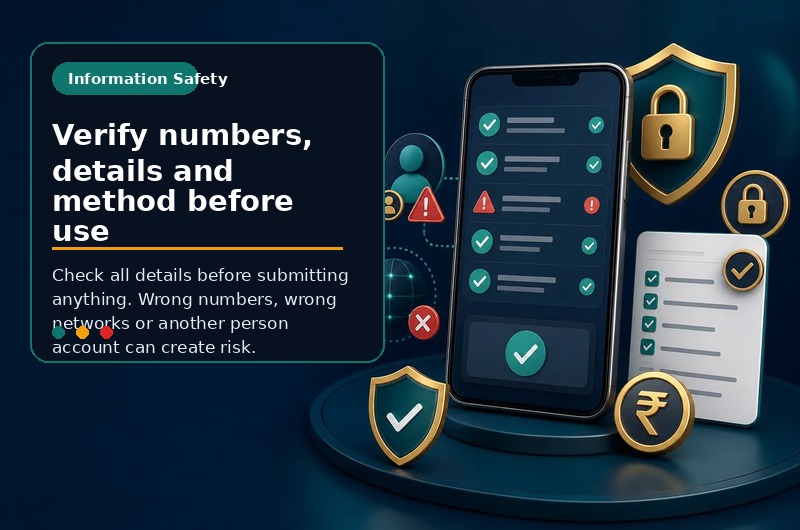
Check all details before submitting anything. Wrong numbers, wrong networks or another person account can create risk.
Use only the payment method currently shown in the account or payment area. Do not rely on old screenshots or forwarded numbers.
Review UPI ID, wallet number, bank account, amount, network type or card response before sending anything.
Keep transaction ID, date, amount, account name and app status. These details matter if payment is pending or failed.
If a payment is pending, do not send another payment quickly. Wait for wallet, bank or account status to become clear.
A UPI payment may stay pending because the bank, wallet or network has not returned a final status. Save the transaction ID and wait before trying again.
Paytm, PhonePe or Google Pay failures may come from wrong ID, low balance, limit, app error or bank response. Check the wallet history first.
Withdrawal status may involve account review, KYC education or rule checks. This page does not provide a fixed processing time.
Issue Handling
Use these examples to slow down and keep records. They are not promises about support, timing or outcome.
Wallet Notes
Wallet or UPI failures can come from bank downtime, incorrect recipient detail, wallet limit, weak connection or an expired payment session. Check the app transaction history first instead of sending another payment immediately.
If money is debited but the account page does not update, keep the UPI reference, amount, time and screenshot of the wallet status. Do not share UPI PIN, OTP or full banking details with anyone claiming to release the payment.
Bank Transfer
USDT Education
Crypto transfers can fail or become unrecoverable if the network, wallet address or token type is wrong. Treat USDT only as a topic to understand unless the current account page clearly shows it as an available method.
Never copy a wallet address from a social-media message without comparing it on the current payment page. A single wrong character or wrong network can create permanent loss.
KYC Education
Some platforms may use account checks for identity, payment ownership or withdrawal review. This page explains KYC as a general concept only and does not confirm a specific requirement for every account.
Use accurate details, keep documents private and do not send identity files to unknown Telegram or WhatsApp accounts. If account review appears, read the current page instructions carefully.
Scam Warning
A message asking for an extra fee to release a withdrawal, unlock a bonus or approve a payment should be treated as a risk signal. Unknown agents may disappear after payment or ask for more sensitive details.
Do not give remote access to your phone, do not share OTP and do not pay from another wallet just because a chat account says the first payment is stuck.
Payment FAQ
Save the UPI transaction ID, amount, time and app status. Wait for the bank or wallet to return a final result before sending another payment or changing methods.
A wallet or UPI payment may fail because of wrong recipient detail, limit, bank response, low balance, app error or network drop. Check the wallet history first.
No. Repeating payments before the first status is clear can create duplicate debits or confusion. Keep the transaction record and wait for a confirmed success or failure.
Check account name, account number, IFSC, amount, bank response and transaction reference. A wrong number or wrong account can create serious recovery problems.
No confirmed support is provided here. USDT is mentioned only as general payment education. If it appears on a current page, network and wallet address must match exactly.
KYC usually means identity or account verification. This page explains the concept only. If any check appears, read the current instructions and keep documents away from unknown social accounts.
No. This website does not process deposits, withdrawals, account review or payment disputes. It only explains safety checks and common payment scenarios for readers.
Treat it as a risk signal, especially if the request comes from Telegram, WhatsApp or an unknown number. Do not pay unknown agents to release payments or unlock withdrawals.
No. UPI PIN, OTP, card CVV, full card number and banking passwords are private. Sharing them can expose your account and payment access.
No. No specific withdrawal time, success rate or payment speed is provided. Read the current terms and keep transaction records for any account-related payment question.